
Service and Authenticity

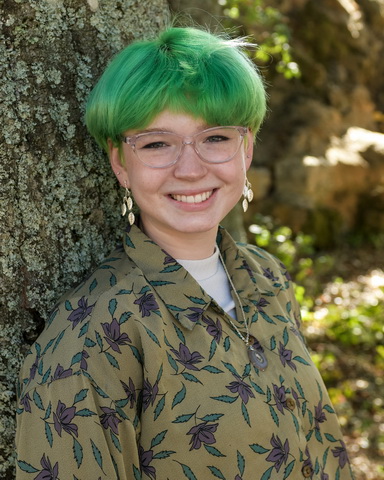
Cy Harris

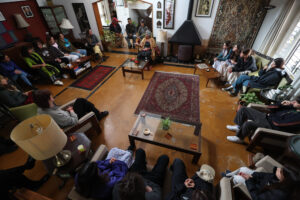
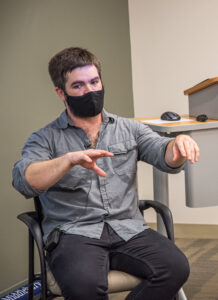
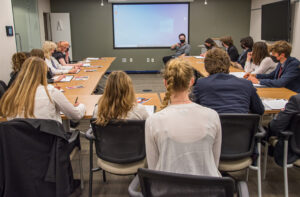
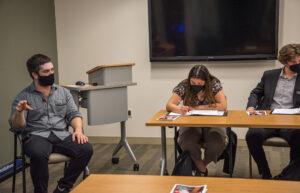
Today, our visit to Woodstock School in Mussoorie proved incredibly inspiring for me. This boarding school is distinguished by its commitment to various core values, one of the main ones being service. We discussed the historical roots of service, traditionally associated with religion, and considered its evolution into something sought after by colleges, often devoid of its original altruistic essence. This transformation reduces acts of service to nothing more than checkboxes on applications, devoid of genuine intent to help others. Woodstock tries to preserve the purity of service for its intrinsic value by encouraging students to start clubs and projects only with genuine interest in them, and to avoid creating these things simply to boost a resume. The teachers work closely with students, and since I plan to become a teacher, I felt that was something I would like to remember when working with students. 
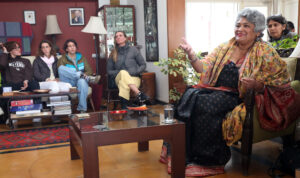
Later, over tea, we had the privilege of conversing with journalist Ranjona Banerji, who highlighted a similar loss of authenticity in journalism. While the United States remains a “North Star” of authentic journalism, much of the industry has become solely for entertainment rather than delivering substantial news. Banerji emphasized the importance of confronting controversial topics and discussed the current trend of media catering solely to personal, preconceived beliefs, thereby stifling meaningful dialogue among diverse perspectives. Our society has become isolated, and we avoid contentious topics crucial for progress. Acknowledging and embracing our differences is incredibly important to prevent further fragmentation and foster genuine understanding. Banerji poignantly reminded us that despite our differences, fundamental human emotions remain universal. She urged each generation to appreciate the nuances of individual experiences, encouraging empathy and dialogue. She said, “Remember what you were like when you were young so you don’t lose that part of you.”I feel that was a strong theme today, not just as a person, but as a society. 

In conclusion, our experience at Woodstock School and the insightful conversation with Ranjona Banerji emphasized the critical need for preserving authenticity in service and journalism, fostering dialogue, and embracing diversity to navigate the complexities of our ever-evolving society. These lessons resonate deeply, serving as guiding principles for personal and collective growth.


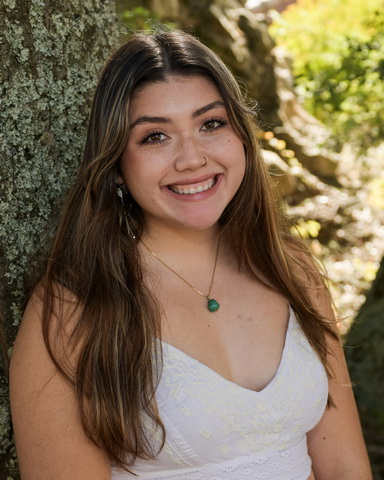
Bella Sol Padilla

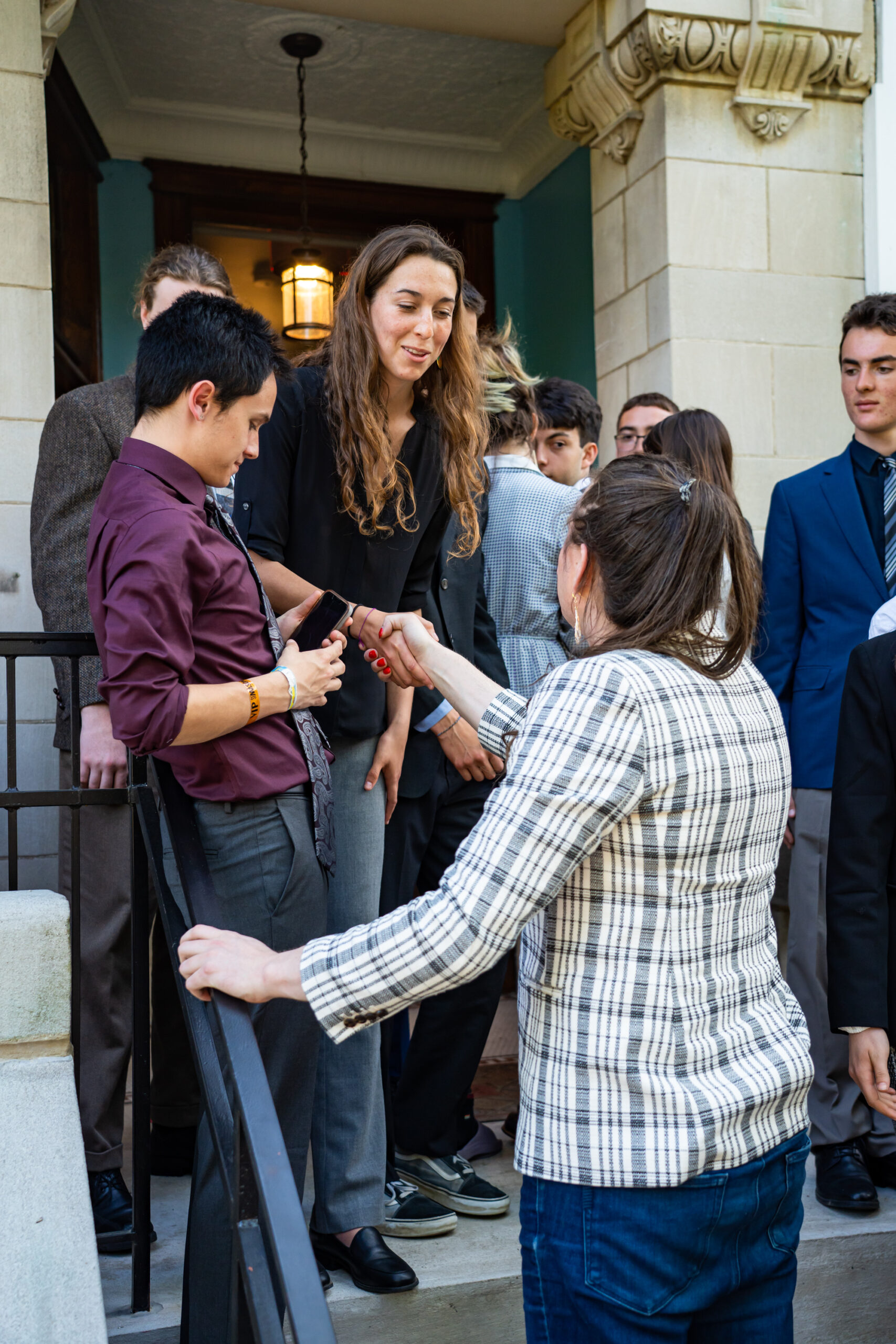
Towards the end of our India trip, while up on the mountain of Mussoorie, we had the opportunity to have a tour of a school called Woodstock. Similar to Mount Madonna, Woodstock is surrounded by mountains and picturesque scenery. Although the weather is usually mild and sunny, we visited on a cold and foggy day. As the mist of the fog blew, my classmates and I hiked up the mountain to the school. The school itself is well maintained, which I found interesting because Woodstock is one of the oldest international boarding schools in India. I would assume the students attending Woodstock would get their mountain legs quickly as our day was filled with climbing steps and trekking through woods. 

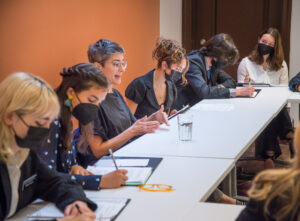
The leader of the tour, Jamie, who is the Director of the Center for Imagination, walked us through the beautiful campus. She spoke to Woodstock’s diverse community. India is well known for being a melting pot of diverse cultures and religions. Naturally, I wasn’t surprised when Jamie told the group that Woodstock fosters students from 36 different countries. It took me a minute to process as my classmates and I all come from the same state. 

Beatrice, one of my classmates, asked Jamie how Woodstock managed to fulfill the needs of students with different language barriers. Jamie explained that there is actually a project in the works that is about native languages and translation. The three main languages taught at Woodstock are English, Hindi, and French. However, it seems that this project will help create more space for students who speak specific languages. Jamie pointed out that through the process of translation, meaning can get lost, so students who participate in the project will have the opportunity to write a piece in their mother tongue, and translate it into English. The purpose is to observe translation and allow the students to express themselves in the language most comfortable to them. 

One of Woodstock’s main principles is service. Woodstock has historical roots as a Christian school, however, students of all backgrounds and religions are welcomed. Something I noticed is that the act of service or giving back to the community plays a large role in any religion, not just Christianity. Students are given the time and space to invent new ways to give back to the community. Whether through their annual fundraisers to raise charity, or through volunteering at local hospitals, students are surrounded by this culture of giving. 

It made me reflect on a community service project my class is involved in. At our school we have pioneered a project that will help restore the lake on campus, called the Lotus Project. This culture is not just prevalent in the school but in all of India as well. I hope to take this culture of giving back home with me and incorporate it into my own work. 


Sophia Manzur

For the longest time, I have found it difficult to feel empathetic towards individuals with opposing opinions. I think my family can attest to this, especially when I feel passionately about certain social issues. As humans, we crave, yearn, and fight for our individuality. That being said, it is easier to categorize ourselves with others who feel similarly, rather than finding a middle ground and coming to the realization that we are all human beings. People (especially politicians) have taken advantage of this and have used it for their own political agendas. We get so concerned with our own views that we don’t realize that sometimes, we are fighting for the same exact thing. 

Today my class had the honor of having a conversation with Ranjona Banerji. Banerji is an Indian journalist who is best known for her insightful and analytical writing. In her time as a journalist, she has contributed to prominent publications, giving them a unique perspective on various social, political, and cultural issues. Banerji’s thought-provoking pieces have set her apart from other journalists in the industry, establishing her as a respected voice in the realm of journalism. 

What I find most inspiring about her work is she tries to breathe humanity into the piece. When reading pieces about certain controversial topics, it is easy to lose the humanity within them. Although I think it is important to have pieces that have a sense of neutrality to them, I find it innovative of her to incorporate her own personality into the piece. 
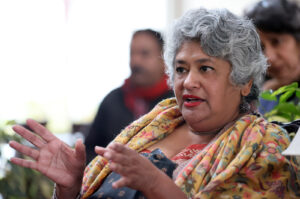
Ranjona Banerji

Banerji also spoke on understanding the different generations. Younger people, like myself, have been trying to change certain customs that have been embedded into our society for hundreds of years. Banerji said that when she was young, her generation was trying to do the exact same thing that my generation is trying to achieve so she tries to remember her own perspective from when she was young to further understand ours. I found this quite beautiful because there can be a notion that you need to shed your old self to become something new. I also see that many people are ashamed or embarrassed of their younger self, which they shouldn’t be. 

Through this conversation, I gathered that even if the opposing opinion is hard to hear, you should still listen, ask questions, and try to understand it. You don’t necessarily have to agree, but it is a step further to finding our common ground. When I grow older, I hope to carry my younger self with me so I am able to understand others and hopefully bridge the gaps within our society.
Only Those with No Power Understand Power

Interview with Charlotte Clymer

Cy Harris

Today, after a scheduling mixup, we finally interviewed Charlotte Clymer. An ally to the LGBTQIA+ community, she was by far my favorite interviewee. I found her diverse and, some might say, contradictory background incredibly fascinating, and the opportunity to speak with her is something I will always value. She began by talking about her military experience and her belief in the importance of public service, whether it is in the military, Peace Corps, health care or any other area that requires service to others. She had a lot of advice related to politics and social issues, the most significant of which to me was the issue of gender inequality. We discussed how both women and men are infantilized and how the only way to overcome this is to maintain high standards for others and ourselves. She stated that the “boys will be boys” attitude is the most offensive thing that can be said about boys or men. Society has a low standard for men. They are expected to be masculine, violent, and in control. When men don’t display these traits, they aren’t seen as men. However, when they do demonstrate these traits and their actions become extreme, we make excuses for them and say, “boys will be boys.” She wants us to raise our standards and show greater respect for men and women alike. Holding a high standard for ourselves makes us good people and encourages those around us to be better as well. 

She also spoke on our shortcomings as a country – not to demoralize us but to motivate us. We as a society need to act on the opportunities that are presented to us. A great example is how countries around the world responded after the attacks on 9/11. Countries around the world, including “enemies” such as Iran, reached out in peace to pay their respects. Unfortunately, we did nothing to foster those potential relationships. On the topic of gun laws, she said that the fact that some states regulate gun purchases responsibly while others do not is ridiculous. The result is that a person can purchase a gun in one state and then travel to another state and use that gun to wreak havoc, and everything up to the point that the gun is used is perfectly legal. This situation results in distrust of our government and our fellow citizens. More effort needs to be put into the fight to change gun laws, international relations, gender inequality, LGBTQIA+ rights – and so much more – but we can do it.


Beatrice Miller

On our final morning in DC, I was excited to interview our last interviewee, Charlotte Clymer. Charlotte is a transgender activist and serves on the DC Commission for Persons with Disabilities. She works to educate, advocate, and create equity and equality in our country. 

I had been very interested to hear from her, specifically on her views of the new generation as we come into positions of power. Something interesting that she said is that only those who have no power understand power. In other words, those who face racial, gender, or other forms of discrimination best understand the effects that decisions by people in power have. Officials who have never had the experience of feeling dehumanized or weak do not really understand the power that they wield. I found her perspective very illuminating, as I had never thought about the effects the decisions of unprepared leaders can have on others, especially when those leaders have no connection to the people affected by their decisions. 
Charlotte has made me think about how I should see others. I should assume that everyone has their own experience with pain in their lives. By not immediately assuming that people are bad just because they think or act differently than I do, I can avoid projecting my own ideas onto them, and I can see them better as real human beings.


Ona Musoll-Buendia

Charlotte Clymer gave me the most unique perspective on my own outlook on our world. She spoke about many different topics, from her connection with God and her faith to controversial topics like gun laws. One of the topics she spoke about that really resonated with me is understanding people from different communities.

She stated that you can only understand other people that have different backgrounds if you interact with them and hang around them. You have to get a sense of the community that they are a part of, such as—LGBTQ+ communities in this case. This statement opened my eyes to see how isolated we can be and how much we really don’t understand one another. We have to wake up and realize that for our world to be the peaceful sanctuary that we strive for, we need to come together as one by respecting each other’s views and developing the capability to understand each other. 

A little later in the interview, she expressed how our task as the future of our nation is to create conversations that lead to consensus, and consensus can only be created if we listen to others. In this day and age, we are focused on what’s right in front of us in the present moment, which can keep us from thinking about the future. An example of this that I see that Charlotte discussed as well is the crisis regarding gun ownership. I see posts on social media platforms that have been expressing their concerns for many years, but no real action has been taken to prevent the abuse of gun rights. In order for us to accomplish the task, we have to be able to push beyond what we know and not only listen but understand.

Our interview with Charlotte was the most mind-altering experience that I have had since coming to DC. I really learned a lot from her regarding what we have to do in order for our country and our world to be the place that we want it to be.


Bella Padilla

Our last day in DC was wonderful. We had the honor of speaking with LGBTQIA+ activist Charlotte Clymer. She is one of the sweetest and most down to earth people I’ve met. It was incredible the way she carried herself with grace and spoke knowledgeably. This interview was the perfect way to wrap up our trip. 

One of my favorite things she said to us is that it’s up to our generation to make a difference. She mentioned that her generation won’t have to deal with the full effects of certain things like climate change, whereas our generation will, and it’s up to us to make a difference. She talked about how hard work can get us anywhere, an idea that all the interviewees this week discussed. I’ll keep that in mind when I’m back home. Another thing she said that’s “coming home with me” is that “hurt people hurt people.” Related to this idea is the idea that the most dangerous person is someone who doesn’t feel heard, and I think it’s our job as a generation to help change that by working to give a voice to everybody.

Be the Volunteer

Interview with Sean O’Keefe

Logan Shaw

Today we interviewed Sean O’Keefe, who has been described as a high level “fixer upper” and has served in a number of important positions, such as Secretary of the Navy and chancellor of Louisiana State University. Currently he is a professor at Maxwell School at Syracuse University. The job that he has held that I found most interesting is head administrator at NASA.

He had a lot to say about his time at NASA. One thing that I found particularly interesting is what he had to say about the new James Webb telescope. He said that no previous telescope compares with it. For example, the Hubble telescope is 350 miles above the surface of the earth, and if we need to perform maintenance on it, we can do so fairly easily. However, the James Webb telescope is a million miles away from earth in the Lagrange Point, a place where the gravity of the sun and the earth are equal so that it can sit freely in space. Because it is above earth’s atmosphere, all the clutter that would normally be in the way of the telescope isn’t there, so it has better views of the universe. However, it is almost impossible to service it, so it must be made much more durable. It took over 17 years to develop it, almost twice as long as it took to put someone on the moon. I thought it was very cool that Mr. O’Keefe helped initiate the development of the telescope. 

Another thing that I thought was interesting was how he dealt with the space shuttle Columbia that disintegrated on re-entry, killing seven people. Shortly afterwards, there was public pressure to launch a shuttle mission to fix the Hubble telescope. He made the decision to cancel the mission because he deemed it too dangerous, even though many astronomers and astronauts wanted the mission to happen. He explained that until the issue that caused the Columbia disaster was fixed, there could be no more missions. I think a valuable takeaway from this would be that you need to use reason instead of emotion to make difficult decisions.


Wyatt Adams

On our last day in DC, we had the opportunity to interview Secretary Sean O’Keefe. We are at the end of the week, so we’re quite tired, but I was looking forward to our talk. Sec. O’Keefe shared two ideas that I found most inspiring. I hope that in my future I can implement these principles in my life. 

The first thing that he said that struck me as important is that no matter what you do or who you are, your actions will always have an impact on somebody else. He made it clear that even the smallest actions will impact somebody at some point. I’m hoping that as I make decisions in life I will keep this in my mind and think before I act. I will try and think about the repercussions of my actions and if they are harming or hurting other people. I am very grateful for this lesson, since I know I need to work on thinking before I act.

Sec. O’Keefe made another important point, that leadership should always take responsibility for the failures of the organization. He emphasized that accountability is the key to progress. Without accountability, anger and outrage become more likely as people search for someone to blame. If leaders of organizations take ownership of the actions of the organization, there is someone to manage conflict and ensure that steps are taken to prevent the problem from happening again. Taking responsibility is often difficult for people, and it takes courage to stand up to other people and continue to defend your decision. Sec. O’Keefe made it very clear that you need to stand by your decisions if you want to make a difference in this world. I have made a few decisions in life, and friends have disagreed with some of the decisions. I usually give in and apologize for my actions, but now, after hearing what Sec. O’Keefe said, I hope to be strong enough to defend my actions even when others disagree.


Erik Howley

Meeting and interviewing Sean O’Keefe was an incredibly insightful and inspiring experience for our class. Secretary O’Keefe shared with us valuable insights and experiences related to the issues of leadership, accountability, and volunteering

Throughout our conversation, he emphasized the importance of taking responsibility for your actions. He stated that leaders must be willing to accept responsibility for the consequences of their actions and decisions. Accountability is especially important in times of crisis, when it is easy and tempting to pass blame to avoid taking responsibility. Sec. O’Keefe stressed that the most effective leaders are the ones who are willing to be accountable to themselves and others, even when things don’t go to as planned.

Sec. O’Keefe also spoke about the importance of being the person in the room who’s willing to volunteer. He explained that volunteering is not just about helping others but an opportunity to develop leadership and gain valuable experience. Stepping up to “be the volunteer” demonstrates initiative, a willingness to take on new challenges, and the readiness to work that is the mark of a true leader.

I believe that this interview resonated deeply with my class and especially me, and we were all inspired by his words. As students, we are constantly learning and developing our leadership skills. Sec. O’Keefe’s insights have given us a better understanding of what it takes to be an effective leader, and we will carry these lessons with us as we continue to develop as people.

Mount Madonna School students with Sean O’Keefe

The American Dream Is Personal

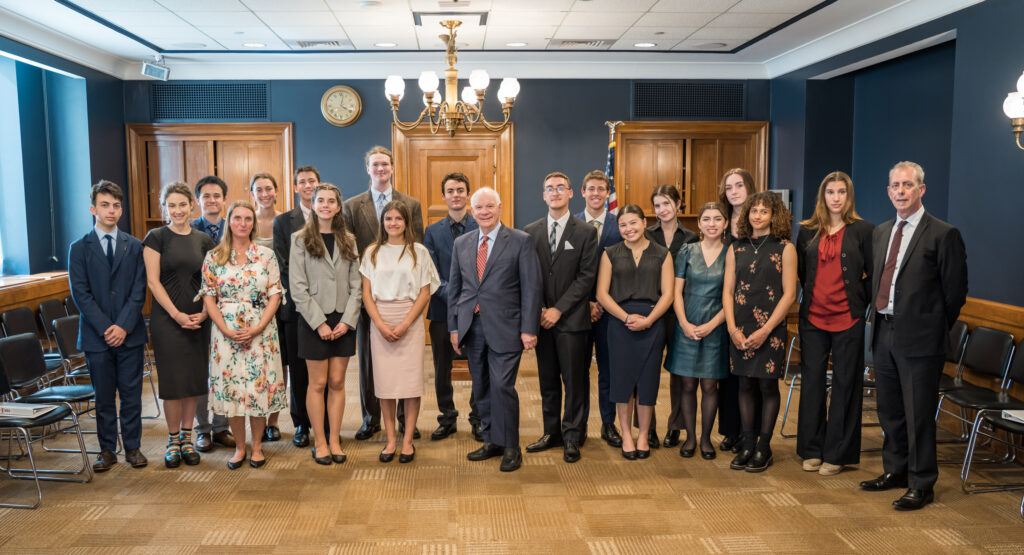
Interview with Senator Ben Cardin

This afternoon we interviewed Senator Cardin, who has held his seat in the Senate since 2007. Our interview with him was short, only thirty minutes. Senator Cardin has been a chairman of the Helsinki Commission since 2006, and in 2015 he was named the Special Representative on Anti-Semitism, Racism, and Intolerance for the OSCE Parliamentary Assembly, a position he still holds. During our interview, Senator Cardin discussed a number of interesting topics, one of them being a bill that the state of Maryland just passed that allows people to work in public service for the government for a year as a way of getting into college. 

When asked what he thinks the American Dream is and whether or not it’s achievable for our generation, he said that his idea of the American Dream is “personal” and comes largely from his grandfather. He told a story about his grandfather selling vegetables from a small cart that he would push down the street. Because of the war in Europe at the time, his grandfather had to decide whether to stay in Europe or move to America. He chose to start a new life in America and work hard to create opportunities for his children. Senator Cardin stated that wants everyone to obtain their own version of the American Dream. I asked him a question about our generation and the number of new and complex issues that affect our future. In his response, he said, “do jobs or engage in hobbies that will make you happy” and to “work hard to meet challenges.”

-Peter S.


Isaiah Orozco

Today I had the pleasure of meeting and interviewing Senator Ben Cardin, a senior US senator from Maryland. I was extremely inspired by what he had to say to us. What stood out for me most was what he had to say about the American Dream: “I think the American Dream is personal, and it is achievable for everyone, but you must work for it.” I found Senator Cardin to be very easy going and open minded. An example of his open mindedness was the way he described working with Republicans in the Senate, many of whom hold very different views from his own. When discussing a recent gun bill that became law, he stated that although it was not everything he wanted, it was far better than nothing, and passing it required cooperation and compromise: “Did I think that was enough? No. Was it progress? Yes. Do I think more needs to be done? Yes, but progress is better than standing still.” I completely agree with his perspective, because we cannot wait around for the perfect gun law while horrible shootings continue to occur, and it is better to fix only part of the problem than to fix none of it. 

Finally, Senator Cardin had plenty of advice for us in the interview: “Expect the unexpected,” “Find out what really satisfies your psyche,” and “You have a lot of time left, so focus on what makes you happy.”

Using Your Voice for Social Impact

Interview with Carla Dirlikov Canales

Wyatt Adams

Today we had the chance to interview Carla Dirlikov Canales, an opera singer who enjoys helping others through art. She has created projects and initiatives that help impoverished communities express themselves through art. She has sung at Carnegie Hall, and she is very intelligent and insightful. Two points stood out to me from our interview with her. 

The first is that she said that whenever she does something, she gives it her all, nothing less than 100%. To do so, she finds it necessary to compartmentalize. When she is doing her music, she focuses on that alone and doesn’t allow herself to become distracted. She even tells her friends that she is focusing on music and doesn’t want to be distracted. I think this is good advice, since I am a minimalist. Ever since a project in fifth grade, I have put the bare minimum into school. I have been told by everyone that I need to put more effort into my schoolwork, but I still haven’t done that. After hearing Carla tell us about how she works and the things that she has accomplished as a result, I feel inspired to start putting in the extra work to succeed. 

The second thing that Carla said that struck me is that in order to succeed you must be stubborn and not give up. Again, people tell me that in order to do well in life I have to go all-out and not give up. When she made this point the first time, I wasn’t moved by what she said, but when she repeated the idea that being stubborn can lead to great results, I realized that if I am persistent enough I really can accomplish anything. She talked about how in order for her to go to college she needed a full ride scholarship. She was offered a scholarship because she is Hispanic, but she didn’t want it. Instead of giving up, she called the person in charge of the scholarship and asked why she didn’t get an academic scholarship, and the person told her that she scored a 27 on the ACT but needed a 28 for a full-ride scholarship. She then re-took the ACT, got a better score, and got the full ride scholarship. I found this story inspiring because she was only a teenager at the time. I’m hoping to keep these two ideas in my mind as I move forward in life.


Logan Shaw

Today, we interviewed Carla Dirlikov Canales, who is an opera singer who focuses on the arts to spread awareness about cultural and social issues. I was really impressed by how much she has accomplished. She has starred in international productions, started projects such as the Canales Project, and she speaks five languages fluently. She also works with the government on the “Turnaround Arts” program, which aims to “turn around” failing schools by getting students involved in the arts. She believes that education in the arts is important to society because it helps to develop a person’s imagination, and imagination is necessary for social change. 

Carla emphasizes that if you persevere anything is possible. She shared an anecdote to illustrate her point. She said that the only way she could get into college was to get a full ride scholarship, and at first she didn’t get one. She then called the college and remained on hold with the admission department for hours. She finally got through to someone and asked what she could have done to get a full-ride scholarship. They told her that if she scored one more point on the ACT she could have received a full ride. She retook the exam and earned the scholarship, allowing her to attend college. 

Carla urged us to connect with her, as having adult mentorship has been a key to her success, and she wants to help others succeed as well. She genuinely wants us to reach out to her, and she gave us her email address and phone number. It was very cool how much she wants to support us throughout our journeys into the future.


Sophia Manzur

Today we interviewed Carla Dirlikov Canales, the founder of the Canales Project,  an organization that celebrates culture and community through art. Carla is also a professional opera singer who performs internationally and has performed at the National Gallery of Art, the Public Theater, and the Kennedy Center. I was especially excited to interview Carla because, like her, I am an artist and Mestiza. Not only do I relate to Carla on a personal level, but I see her as an iconic figure because, like her, I hope to use art to bring communities together. 

I asked Carla the following question: “You created The Canales Project for people to share their personal experiences with culture and identity through music and conversation. At times, dealing with the tensions that can arise when one is raised in different distinct cultural environments can make one feel as though they are living ‘between two worlds.’ Being Mestiza, I struggle with feeling connected to my Mexican roots because I have grown up surrounded by a completely different culture. What can those who feel lost regarding their cultural identity learn from your project?” Carla responded that she has always felt like she was lost in her cultural identity. Her mother is Mexican, and her father is Bulgarian. Carla spoke about having to learn two completely different cultures in addition to American culture. She wants to help those who also struggle to find their own cultural identity. She says that she uses her art as a platform for others to achieve their personal goals. 

During the summer of 2022, I attended California State Summer School for the Arts, a theater arts program. On my first day there, my acting studio teacher asked us if we are in love with theater and why. At first I responded that of course I am in love with the arts because I have an indescribably great feeling when I perform. Upon reflection, however, I realized that I didn’t really understand why I have this great feeling when I perform. What Carla said about why she loves the arts helped me identify why I have this feeling. Carla said that all humans have emotions, and art is a way for us to express them. No matter what differences we have, we are able to connect with one another through the arts. I don’t think there is anything more beautiful than being able to express yourself with others as part of a loving community. 

Although I live “between two worlds” and have had difficulty finding my own identity, when I’m dancing, singing, writing poetry, or acting, those two worlds coexist in harmony. When I immerse myself in my art, I am authentic and true to myself in a way that better allows others to see me not as belonging to one world or the other but simply as me. I am grateful to Carla for helping me understand myself and my motivations better.

Everybody Is Somebody’s Child

Interview with Judge Karen Friedman

Erin Kavitsky

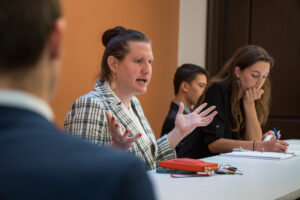
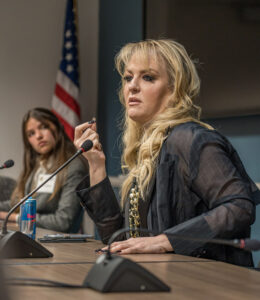
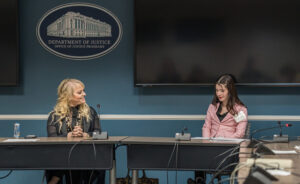
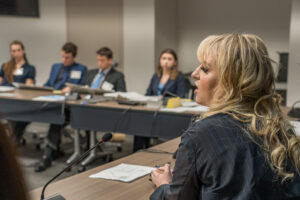
Today we returned to the Office of Justice Programs at the Department of Justice to interview Judge Karen Friedman. She talked a great deal about her life and work including how she came to be a judge and how she grew up. The first thing I noticed about her is her style. I usually think of judges as people who don’t ever dress up or express themselves through fashion and clothing, but she does not fit that stereotype. She entered the room in an all-black outfit that looked like it had been styled by a designer. The only thing that had color to it was the Louis Vuitton bag that she brought with her. She is proof that not all judges need to look bland and serious. She showed up eager to talk to us, and she made interviewing her easy and fun. She made everyone feel comfortable around her, but she also gave the impression that she has no tolerance for disrespect. I was very impressed with her.

Another thing I noticed and admired about her was that she feels strongly that children should be tried in court as children. She explained that she believes that everybody is a child of God and therefore should be treated with respect. Even if someone comes to her in handcuffs, she wants to make sure that person is heard and respected. She wants people on trial to know that she is doing her job according to the law and that it is not personal when she sentences people to jail. She explained that everybody is somebody’s child, so it is her duty to treat everyone with respect because, at the end of the day, the person standing before her is as much a human being as you and I.


Bella Padilla

Today we had the opportunity to interview Judge Karen Friedman. From the moment she walked into the room she commanded attention with her presence. She wore a most stunning outfit that was paired with the most luxurious Louis Vuitton bag. She was lovely as we interviewed her.

I was fortunate to ask the first question, and I enjoyed her answer. She stated that, in her opinion, everyone is made in the image of God, so everybody deserves to be treated with respect. According to her, it doesn’t matter who she’s talking to, or whether they’re in an orange suit with handcuffs or not: they deserve to be heard and respected. 

Her ability to humanize everyone she encounters has helped her make connections with individuals that benefit everyone. She told us a story of someone she helped escape the justice system by putting them into an addiction program. Because she saw the person before her as a human being who needed help, she was able to give him the help he needed to overcome his addiction. Not only did she and that person find mutual respect, but she maintains a real relationship with him to this day.

I’m very grateful for the time she spent with us today, and I think I’ll always remember what she shared with us.


Ethan Lee

Today, our class interviewed Judge Karen Friedman. Everybody was looking forward to this interview, and I think that everybody’s expectations were not only met but exceeded.

She has an amazing presence, and the way that she spoke to us made us feel heard and appreciated. All of her answers included great detail, and she was clearly excited to be talking about important issues with us. I liked it when she said that many people are well aware of how to deal with issues pertaining to child incarceration, but the issue is getting government officials to do something about it. I also like that, when asked about what is important when choosing a school, she stated that the “best” school isn’t necessarily the school that is best for you. She talked about her son’s search for a law school and trying to find the best fit for him. Both Harvard and Yale, the two most prestigious law schools in the country, accepted him. Yale attracts many liberal-minded students, and although that isn’t a bad thing, Judge Friedman believes that it is good to be exposed to views that differ from one’s own. This among many other factors, is why he has decided to attend Harvard.

I also liked that she is one of the most “human” judges I’ve seen, as she talked a lot about making personal connections with the people she sees in her courtroom. No matter who comes through her door or the background they bring with them, she treats every person with the same respect that everyone deserves. “Everybody is somebody’s child,” she said. I can’t think of a better way to approach cases, because not all cases are the same and not all individuals have the same story, but everyone deserves to be treated fairly.


Emma Monclus

I knew as I researched Judge Karen Friedman’s biography that she was going to be fun to interview, and as she walked into the room I knew she would not disappoint. She sported stylish clothing, several large white necklaces, long lashes, black acrylic nails, blonde curled hair, and high heels. She also has a large “presence” that demands attention.

She was captivating as she answered the questions we had for her, and she gave long answers that anticipated other questions we had lined up. She clearly loves to talk, but everything that she said was important and inspirational, and I found myself taking notes on everything she said. She also has good morals and character traits. It was incredible how fairly and equitably she treats everyone: “Even if they’re in chains, even if they’re a drug addict, even if they have mental health issues … every single person has a piece of the divine in them … every single person deserves a level of respect because they all represent the divine.” Clearly, faith plays a large role in her life. Her open mindedness and willingness to change the world was extremely refreshing to see, as it made me realize that there are quality people working to make our criminal justice system better.


Irulan Cockrum

Today we interviewed Judge Karen Friedman, a presidential appointee at the Bureau of Justice Assistance. She is known best for her expertise on the intersection of criminal justice and behavioral health and for her unique approach to sentencing and probation, being very open minded towards every person she meets in court. 

One thing I really appreciated about her is that she implements her faith into her work. She works not just with her brain and facts but with her heart and emotions. She explained that she was raised very religious and to see every person as “made in the image of God.” She brings this positivity and open mindedness to her work and always asks herself, “How can I help someone as a child of God?”

I think this is a beautifully nondiscriminatory and accepting way to treat people. She told us a story about a case she had in which a man was charged for assault, and that he had a clear history of alcohol and drug abuse. Instead of sending him to jail, she sent him to a recovery program. She explained that he had been using drugs since the age of eight and that, now in his 50s, he is completely sober. In her courtroom, he had begged her to send him to jail and not to a treatment program, but she was adamant that he attend the program, and as a result he has made a remarkable recovery.

I asked her to share why she chooses to express herself through fashion. Before the interview, I had learned that she always dresses in designer clothes, even when she visits prisons. I found this fact about her incredible and unique, especially since she is one of the top judges in the country. She told me that a love of fashion has always been a part of her personality. I admired her for this because it shows that she does not let the opinions of others dictate who she is or how she expresses herself. In a world of constant judgment and criticism, it is refreshing to see someone in a profession such as hers who is unafraid to be herself.

As she left the interview, she whispered to me, “Stay fashionable.” I smiled as I appreciated both her spirit and her advice to stay authentic. 

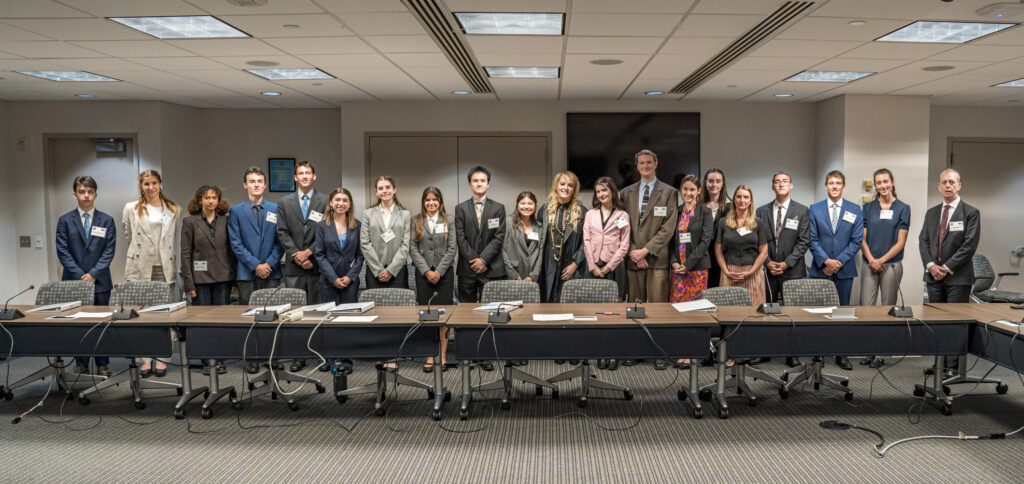
Mount Madonna School students with Judge Karen Friedman

“America’s Greatest Contribution to the World Has Been Its Values”

Interview with Senator Ben Cardin

Addy Catterall-Pendleton
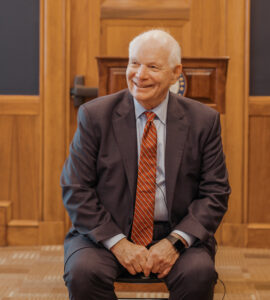
Senator Ben Cardin

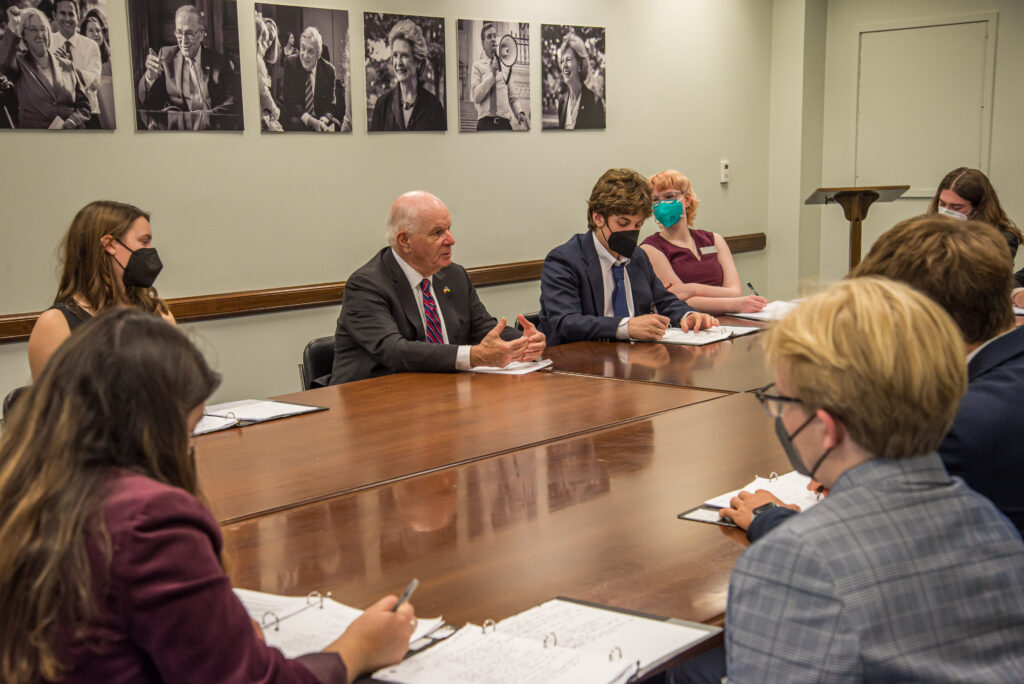
Today we interviewed Maryland Senator Ben Cardin. While we only had a short, thirty-minute interview with him, he nevertheless had time to say some really interesting things. He spoke about immigration law, noting that in the US two of our foundational values are freedom and opportunity. America is, after all, the Land of Opportunity. However, we cannot claim this title if we cannot provide equal freedom and opportunity to those who come to this country to become Americans. Current immigration laws do not reflect American ideals: “America, in its actions, is not living up to its values.” Currently, we reject too many people who seek a better life and better opportunities, and we reject people who seek political asylum, including people who have fled their country to escape persecution and human rights violations. 

I also appreciated Cardin’s view that political campaigns should be more transparent. He told us that he takes the time to go to rural areas of Maryland, talk to the people there, and work on their behalf, even though he knows that it is quite difficult to change people’s minds and that he most likely will not be getting their votes. Even though he doesn’t need those votes to get elected—as he receives enough votes from cities like Baltimore—he still makes an effort to work on behalf of all the people in his state.


Sky Weir

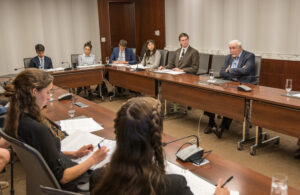
Today we toured the Capitol and interviewed Sen. Ben Cardin (Maryland). The interview with Senator Cardin was for me the most interesting interview we have had on this trip. It seemed that everyone was looking forward to it. The tour of the Capitol prior to the interview was packed with information, such as the history of various statues and the story of the three artists who painted the dome of the Capitol. We all eagerly anticipated the interview as we ate lunch in the Senate cafeteria, one of the best meals of the trip so far. After Sen. Cardin entered the room, we all stood to greet him, and he made a funny remark that released some of the tension we all shared. We had originally planned for an hour with him, but we were informed that he could only stay for twenty-five minutes, forcing us to streamline our interview to six key questions, all of which provoked thoughtful answers on his part.

Throughout all of the interviews this week there has been a common theme of listening to the other side and coming to a compromise. Cardin too focused on the importance of this theme in several of his answers. We then asked questions about voter suppression, and Cardin responded with the claim that voter suppression negatively affects everyone. He also commented on the fact that we need to change the way we finance elections to make our democracy less partisan. He passionately argued that there needs to be more financial transparency in political campaigns, which seems to me to be necessary if we are to maintain and strengthen our democracy.

He made an important point about the need to be more loyal to our country than we are to our political parties, and he noted that, historically, “when we have a threat, we put the country first.” He then placed his hand on the desk and said in a very solemn tone, “we should do that more often.” This for me was a “wow” moment: I could see his genuine passion for what he does, and I could tell that his own sense of morality pushes him to be his best self in politics. 

As the trip is wrapping up, I find myself looking back to our first day here and contrasting it with where we are now. I’ve had many profound experiences and been exposed to views I had not encountered before, making me think deeply about many aspects of my own life. This trip has deepened my understanding of how the US government works, which I know will be most important in the future.

Geolocation Dave

Meeting with David Schmerler at the James Martin Center for Nonproliferation Studies

Jacob Sirk-Traugh
David Schmerler

Today we traveled to the James Martin Center for Nonproliferation Studies (CNS) and interviewed Dave Schmerler, a Senior Research Associate. CNS is a non-government organization dedicated to the prevention of nuclear proliferation and war, and Dave deals specifically with North Korean intelligence. As a geolocationist, he looks closely at North Korean media and tries to gather information such as the location of nuclear testing sites and the level of advancement of their nuclear technology.

He began our talk with a short slide show and then took our prepared questions. One answer that was surprising to me was when he told us that CNS’s technology is miles behind whatever the federal government uses, and that his job is more about educating the public and providing meaningful analysis. He told us that any threats requiring immediate action are seen first by the government, and that CNS does not play a role in gathering intelligence or in any response to what the government finds. He showcased the software that he uses to detect photoshopping in official photos by countries like North Korea and Iran. The software just detects heat, so if a photo shows a rocket propulsion flame without heat waves, he knows that the photo is probably fake, and that the rocket probably did not launch.

The interview was very unique, because Dave is closer to our age than are the other interviewees so far, and we were therefore able to talk to him more informally. Our interview felt like a conversation, and at the end of our planned questions we were able to come up with at least fifteen more questions off the top of our heads—something that had not happened in the other interviews.

The most interesting thing he talked about was his process of determining where a North Korean testing site is located based on nothing more than a picture of a Korean building with some missile smoke in it. With an entire country to search, it’s amazing that he is able to do this. We learned—much to his embarrassment—that an old nickname of his is “Geolocation Jesus.”

At the end of the interview, he let us use his VR headset to look at a 3D model he created of a North Korean nuclear weapons lab. This interview was my favorite so far because of how he piqued our interest and allowed us to interact so informally with him. This informality encouraged us to ask the questions we were genuinely interested in asking. He is clearly very smart, and I was impressed both with his ability and the way he answered our questions.


Kayla Goldstein

Today was an incredible experience for me. Our interview with Dave Schmerler not only fascinated me, but it was so stimulating that I asked more questions in this one interview than I’ve asked over the course of this trip so far. Schmerler is young yet incredibly well-educated in his field, and there was so much to talk about that I could have asked him questions for hours on end.

Dave Schmerler specializes in terrorism studies, and his primary tool for investigation is open-source geolocation technology. He uses resources such as satellite images, image tracing, and even social media to determine what is in photos and when they were taken. He uses the information from these photos to monitor nuclear weapon sites in North Korea and Iran. 

Dave explained geolocation to us, and I was genuinely amazed at how he utilizes it. He uses pictures from weapon launching sites to determine where those launching sites are, even though almost all of the official photos of those sites are blurred in order to keep the locations secret. He uncovers state secrets using the information from photos! Talking to him and hearing about how he narrows down the location of one photo from almost nothing—often only knowing what country it was taken in—was mind-blowing (get it?). 

This interview was unique because of how young Schmerler is. It’s inspirational to see someone who is not only passionate about what he’s doing but incorporating what he loves into his job. Dave has a fascination with video games and virtual reality, and he uses those resources to further his work. He uses 3D virtual models to make displays of the bases he’s found in North Korea, and he has even used Minecraft to make his work more accessible to the general public. It was very satisfying to ask such an intellectual any question that popped into my head. I am grateful for the opportunity to talk to him, and I hope that younger Mount Madonna students can interview him and enjoy the same unforgettable experience that I had today.


Everyone Deserves the Opportunity to Share Their Story

Interview with Alexandra Toma, Executive Director of the Peace and Security Funders Group

Alyssa Manzur
Alexandra Toma

This morning, we had the opportunity to interview Alexandra Toma from the comfort of our hostel, which I very much enjoyed. Toma is a philanthropist, the executive director at the Peace and Security Funders Group based in Washington, DC. She is also a refugee who uses her platform to give voice to and help other refugees. 

Two important values in my life are self expression and equality. I believe that everyone deserves the opportunity to share their story—who they are and what they stand for—without fear of not fitting in, being judged, or being harmed in some way. I found Toma’s words reassuring when she spoke about her values and how she strives to implement them in her work and life. She mentioned that if one has the power and privilege to use their voice, one should use it in a way that challenges assumptions and that makes people think differently. It was evident that Toma believes in standing one’s ground when faced with adversity, having the courage to speak up for one’s values, and treating everyone equally without judgment or assumptions. These are messages that more people, regardless of age, need to hear. 

She stated that the key to mobilizing others to create positive change in their communities is to share their stories. When we are able to connect with each other on a personal, human level, by listening to each other’s stories, different perspectives are acknowledged, and positive change becomes possible.

I am grateful for the time we spent with Toma, as well as for her willingness to stand up for what she believes in to better the world for others who do not have the same opportunities. I find her mission of selfless service truly admirable and inspiring.


Summer Howley

Until today, we have been rushing to make it to our interviews and activities on time. This morning, however, we had the luxury of conducting the first interview of the day in the space we use as a work room in our hostel. As a result, I felt less nervous for this interview than I did for the others, as we were in familiar territory. We met with Alexandra Toma, executive director of the Peace and Security Funders Group (PSFG), which is “a network of foundations and individual philanthropists investing in peace and global security,” according to the website. 

I had heard of NGOs before. In Model UN we use them as an easy source of funding, but prior to doing research for this interview and speaking with Toma, I knew nothing more than about them. I was thus interested to learn more about such organizations, which operate behind the scenes and don’t necessarily receive all the press or credit they deserve. Toma described how PSFG responded to the humanitarian crisis in the Central African Republic, “go[ing] in kind of like the tip of a spear,” and thus “able to use a little bit of our money and leverage and a lot of money from the United States government.” Her description reminded me of how some people talk about trading stock: you might start with a little, but a little can eventually go a long way. 

One theme that arose multiple times throughout the interview was that of public speaking skills. Although she said that such skills are not necessary for everyone, they have been helpful in her career. In particular, she said, her high school speech and debate courses taught her how to “stop and think about how to answer [questions] in a way that’s valuable to my audience.”

Another thing that struck me was simply how much she has accomplished. When asked what advice or reflections she has, based on her college experience, she replied that “you don’t know what you don’t know,” so “just try everything once in your life.” She has worked as a paralegal, an embassy intern in Stockholm, a shadow to a surgeon, and several other occupations—all because she pursued opportunities and possibilities. It was inspiring to see someone who is unafraid to try new things and able to follow through on her interests. It is both terrifying and liberating to realize that my plans for the future are not entirely concrete, and it’s possible—even probable—that my plans will change.